
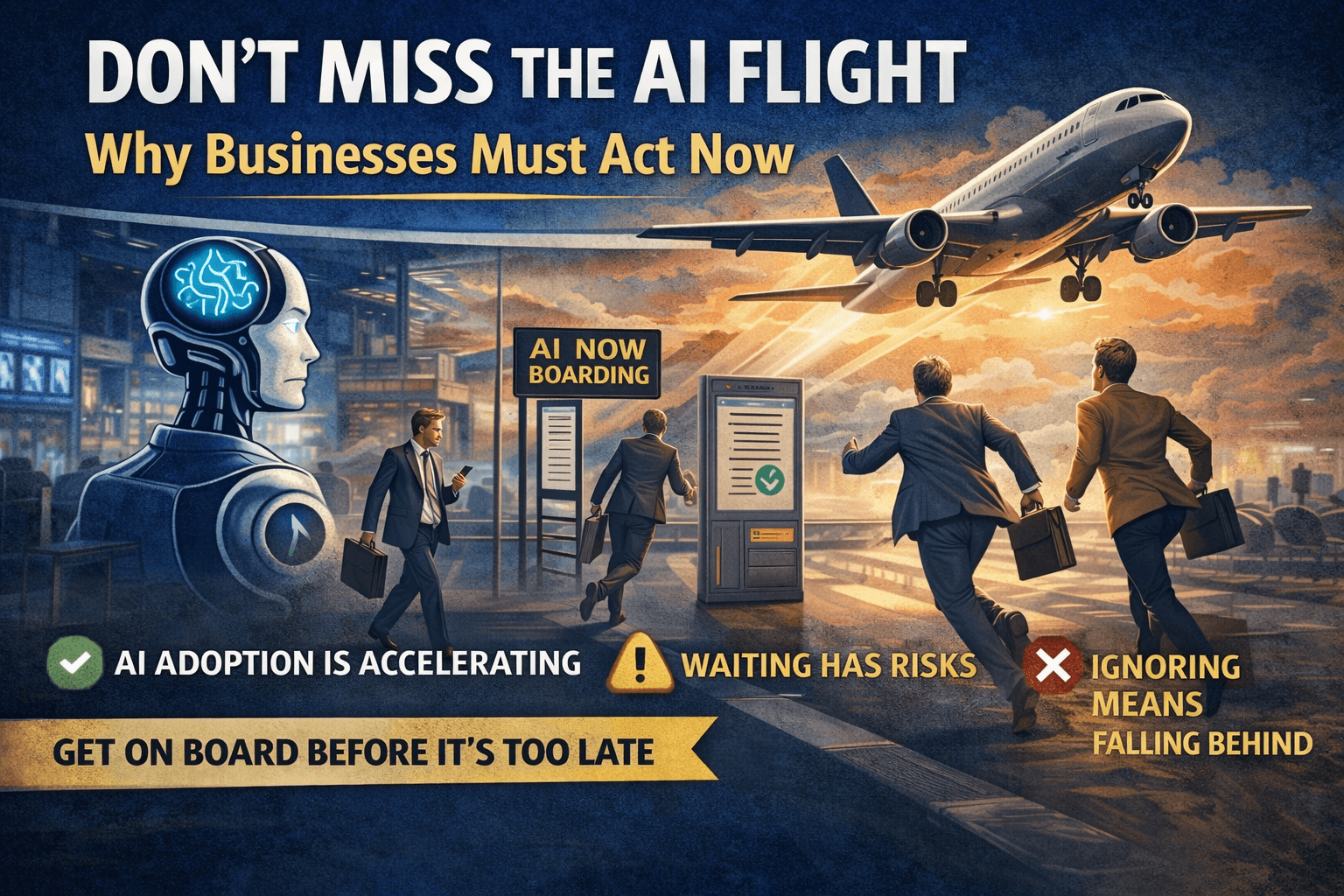
Artificial intelligence is no longer a future concept or an experimental tool reserved for tech companies. It is becoming a fundamental part of how businesses operate, compete, and grow. The question is no longer whether AI will impact your organization, but whether you will be ready when it does.
At Ledge, Inc., AI is viewed as a practical capability that must be adopted with intention, structure, and guardrails. Waiting too long carries real risk, especially as competitors begin to build momentum and capabilities that are difficult to catch up to later.
The AI Moment Feels Familiar for a Reason
AI adoption today closely mirrors the early days of the internet. Some organizations moved early and gained a lasting advantage. Others waited, unsure of the risks, only to find that participation eventually became unavoidable.
Right now, businesses tend to fall into three groups:
Early adopters who are actively experimenting and building use cases
Cautious adopters who are watching and waiting for clarity
Organizations at risk of opting out entirely due to fear or uncertainty
The concern is not that every business must be first. The concern is being last. Once AI-driven workflows become standard, catching up becomes far more difficult.
Real Business Value Is Already Showing Up
AI is already delivering measurable results across industries, not just in manufacturing or technology. Ledge is seeing adoption in service organizations, consulting firms, accounting practices, and internal operations.
Examples include:
Reviewing large document packages quickly and consistently
Comparing incoming customer or supplier requirements against internal standards
Running scenario analysis to understand business risk and opportunity
Identifying patterns in large data sets that are difficult to spot manually
These are not abstract use cases. They directly support decision-making, risk management, and operational efficiency.
Scenario Planning and Financial Visibility
One of the most powerful applications of AI is scenario development. Businesses can model what happens if prices increase, costs rise, or staffing changes occur.
Tools such as short-term cash flow planners allow teams to test multiple scenarios quickly. Understanding how changes impact cash flow over a 13 or 20 week horizon helps leaders make better decisions when timing and liquidity matter most.
This kind of insight used to require significant time and effort. AI makes it faster and more accessible.
Addressing the Fear of Over-Reliance
One common concern is that teams may become overly dependent on AI and stop thinking critically. That risk is real, but it is manageable.
Ledge encourages workflows that require review and judgment rather than blind acceptance. One effective approach is separating content generation from final formatting. When teams must move AI-generated content into approved templates, an additional review step is naturally introduced.
Another safeguard is confidence scoring. AI tools can assess their own outputs and provide a confidence level. When confidence is low, it signals the need for deeper human review. This helps teams use AI as a partner, not a shortcut.
Security and Data Protection Cannot Be an Afterthought
Security is one of the most justified concerns around AI adoption. Many employees already use AI tools at work, often without approval or oversight. This creates real risk around intellectual property, customer data, and internal information.
A responsible approach starts with policy. Businesses should define:
Which tools are approved
Which data types are acceptable for AI use
How access and accountability are managed
Ledge also emphasizes the importance of tools that do not learn from client data. Using closed systems reduces exposure and allows organizations to benefit from AI without compromising sensitive information.
Policy, Access, and Enablement
AI adoption should not be driven solely by leadership mandates. It works best when teams are given access, clear boundaries, and support.
Effective adoption includes:
A clear AI policy that aligns with business risk
Approved tools that meet security requirements
Training on how to work with AI, not just use it
Ongoing identification of real use cases across the organization
Ignoring the reality that employees are already experimenting with AI only increases risk. Providing structure reduces it.
Video Transcript
Hello, this is Adam Marsh. I’m the president at Ledge Inc. I’m excited today to jump in, discuss some AI, address some concerns, and talk about how we see the direction of the current AI tools and where we’re heading with them. So I was sitting at the airport coming home from a family vacation and had my laptop out working on a few tools. And I recognized as we’re looking at the gate that AI has a lot of similarities to sitting at the airport. And really, I could see it that if you’re not jumping on board, you’re about to miss the most important flight of your career. We’ve got two types of people there. We’ve got people who are early borders, the ones who are ready to jump on, who are standing in line, they’re on that southwest flight, they’re the ones with the A column and ready to go, ready to get in line. You’ve got the other folks who wait till last second to jump on and then the rest of them who may be running through the airport trying to catch that flight. As we see it, we see more and more people considering missing the flight altogether and being worried about it. And I’m concerned that as this new technology takes off, this is like the internet where if you didn’t jump in early, at some point it’s going to be there and you’re going to have to jump in. So we’re seeing real success stories across industries, not just manufacturing, not just super high tech. We’re using it in the service industry, absolutely. For our team where last night I was building some scheduling tools so we can make sure we optimize our team’s time and who’s allocated to which projects. We’re working with some accounting firms as they look to help to review document sets and help to do projections for their customers.
We’re working with many manufacturers who are interested in using these tools to speed themselves up. And then we see it across a lot of consulting. We see potential game changers here, things like document package review. And that’s not just going out. That’s not just looking at the work product that you did and making sure that it looks good before it gets to that customer, but it’s also looking at the documents that are coming in and comparing them to your internal documents. When we get handed a supplier quality manual and a series of requirements that are hundreds of pages long and stretch across multiple documents, what if instead we used AI to help scan those and at least give a first review to say, “Hey, can we even meet the requirements of this? ” The other area that we’re seeing a ton of really strong results is in scenario development where we can test things.
We can say, “Hey, what if this happens?” And really quickly get a result to try to understand what sort of the impact there is. And a great example of that is we built a tool to do some projections on cash flow. So say a 13 week or a 20 week cash flow planner based on your AP and your AR. Building in the what if scenarios to say, “Hey, what if our pricing goes up? What if our internal costs go up? What if we have to hire a new employee? How does it impact our cash flow?” And as cash is king, understanding those impacts is really big, is really critical. Then we’re seeing it on helping to identify patterns in large data sets. So utilizing AI to sort of see the things that would be difficult for you to see, rather than slicing and dicing that Excel sheet one more time, let’s let AI start to review data sets, look for those trends, and then dive into the details.
We understand there are real fears. There’s certainly a fear that your team could get lazy and start to just say, “Hey, here’s my document. AI made it. Looks good. Send it. Moving on. “That’s real. And so we’re working to address those fears with a couple different tools. Number one, I’m not thrilled with AI’s ability to make really strong formatted, nice looking documents anyways. If everybody knows sort of what happens with Microsoft Word, when you use AI to make it and then you maybe say try to change a layout, it’s a mess. It looks like maybe the page exploded if you tried to add in a space somewhere. So instead, what I’m asking people to do is say, “You know what? Create the content, force your team to copy and paste that into your template.” When you do that, you force part of a review. However, the thing that’s been really strong for us is asking the tools that we build to layer in a confidence percentage.
So let AI, look at what it built, analyze it, and give you some confidence on how happy is it with the answer? How many sources did it get? Those kind of things. Once you do that, your team will have to sort of look at what they’ve built and then understand, you know what? If AI is only 75% confident in what it gave me here, I really need to spend some more time on it. So that way we avoid that blind copy paste, give them the ability to use the tools, but work with it. I am very concerned that people will copy and paste. And I got to tell you, good engineers don’t do that. Good engineers instead use these tools and help guide them, right? So work with it, become sort of that partner, that thinking partner instead of just the solution.
The next big concern that we’re seeing is really around security, and this is absolutely well founded. I see folks either being very cavalier about it and jumping in using tools that they shouldn’t be using. Say just your baseline ChatGPT and then throwing in customer information. And that’s a real concern for companies to maybe lose their IP and risk letting into the world sort of the things that you’re putting out there. It’s sort of easily hacked. It’s not controlled by your IT department to know what those logins are. There’s no accountability as to what people are putting in. So we have a couple tools that we really suggest people dive in and start using as a solution to that. And the first really important one is working with your company to develop their AI policy. And that AI policy should have a couple layers. In my world, I think you really start to define which data sets are appropriate to use.
Look, if we’re building some marketing material and we need a new image, then please let’s go ahead. Let’s just use ChatGPT and we’re going to help generate an image. That’s fine. But if we’re going to analyze maybe some internal financial data, those things don’t belong in sort of that ChatGPT world. Instead, I really look at using other tools. The tool that we are able to offer at ledge.hats.ai really focuses on AI that doesn’t learn. And so we’re able to get the advantages of a large language model where we can communicate with it, but be rest assured that it isn’t actually taking our information, learning from it and executing on it. And so that’s a huge deal for us and it’s a way we’ve been able to address a lot of these concerns. So work with your team to a couple things. One, identify the tools that’ll work for you, identify the data types, and then build policy around it.
These things are going to be login policies. They’re going to be all those kind of things that you would have, but recognizing that your team are using it, right? I mean, you got to think over half of people are using AI tools right now to do things at work. They’re probably unapproved tools and that’s really concerning. Especially as a business owner, I’d be concerned that folks are dropping things in that I’m not aware of and could be putting us at risk. So instead, we’re looking at sort of what are the alternatives there. There’s some urgency here, folks. You don’t have to be first, but you can’t afford to be last. Competitors are already finding their seats on this plane, and so the doors are closing. We need to get on and you need to start working with it. And I know there’s fear, so let’s work on mitigating those fears before you jump in.
So reach out to us if you would like to learn more about how we’re using AI. We’re looking for more and more use cases. Every week, I’m building another tool or two. I’m demoing this all over the country for many companies as they look for, “Hey, what are the solutions? Where can we start using AI today?” Recognizing that it’s only getting better. Today is the worst AI you’ve ever used. I think we’ve all heard that before, right? That’s great. But if you don’t understand how to use today’s AI, in six months from now, you’re going to be leaps and bounds behind. This is not like a slow moving boat. Maybe we can go catch it. This is an airplane. You better jump on because it’s taken off and there’s no bringing it back. So as we look at this, I really ask that you start looking into, are you going to be that early border?
Are you going to wait or are you going to miss the flight? There’s some certainly game changers where we can dive in, start using this for document review. We can start using it for scenario development, pattern recognition. There’s all kinds of tools that we can start building. Check out our YouTube feed. We’re posting videos of these tools in action and just starting to plant the seed with how you can use AI. Understand that there’s fears. There’s fears for teams getting lazy, not using it. Look, were we worried about them using the internet for research before? Well, now we trust them to use the internet for research. So think about using AI in that way. We’re going to start working with it to use it, understand how to use it. The other fears around security, how is your team going to address that? Let’s dive in.
Let’s build that AI policy, get with us. We have a free AI policy that we give away. Love to show it to you and walk you through sort of our thoughts from there. Then we would love to help you identify potential use cases. And then look, it’s time to jump on board for this flight. So don’t miss your flight. Let’s jump in. Let’s start using AI today and let’s use it in a safe and secure way. Thank you. Reach out to us at toddb174.sg-host.com/ to learn more. We’d love to help you out and watch our YouTube videos to catch the next one. Thanks.